Important: There is no standard, fixed, or required commission rate in real estate. All commission rates are fully negotiable — by law and in practice. Any commission figures referenced on this site are for illustrative purposes only and should not be interpreted as typical, customary, or recommended rates.
Your Money. Your Rights. Your Fight.
Tracking the lawsuits that are putting billions back in homeowners' pockets
Court Documents Verified
Lawsuits Tracked
In Settlements
Major Law Firms
The Fight Is Working
Real money being returned to real homeowners
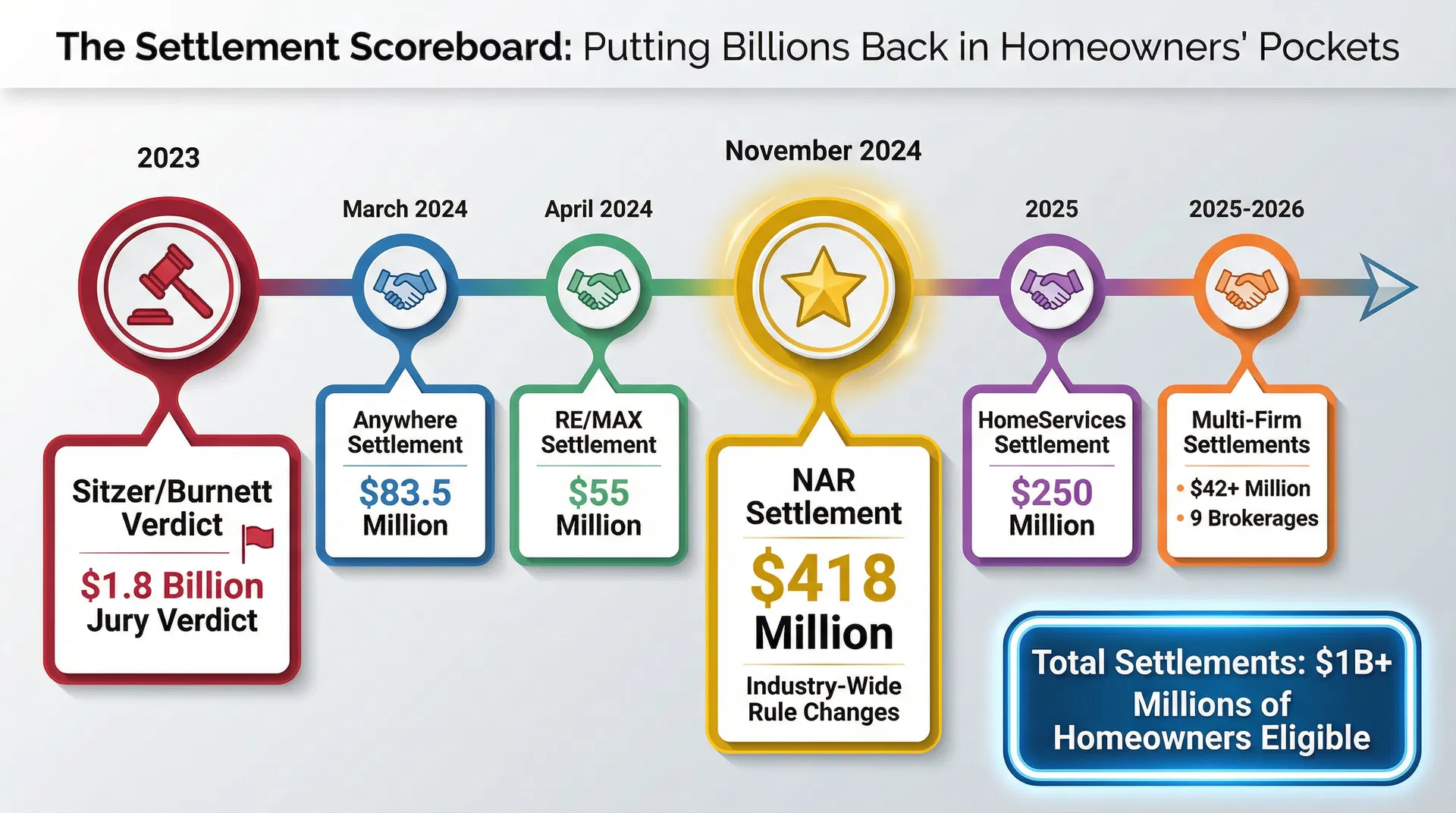
Including $418M NAR, $250M HomeServices of America, $42M Moehrl, $20M Keller Williams, $8.5M RE/MAX, and ongoing cases
Class actions covering home sales from 2015-2024 across all 50 states
NAR eliminated mandatory buyer broker commission offers as of August 2024
eXp & Weichert Settle Hooper for $44M
eXp World Holdings and Weichert agreed to a combined $42.5M in the Hooper buyer-broker case — a new lawsuit separate from Batton and Tuccori.
Anywhere Gets Tuccori Preliminary Approval
Judge Bough granted preliminary approval for Anywhere Real Estate + 3 brokerages ($10.8M). Batton plaintiffs' intervention bid denied.
Introduction
Imagine selling your $500,000 home and writing a check for $30,000 in commissions—$15,000 of which goes to the buyer's agent, someone you never hired and who was working against your interests in the negotiation. Until recently, that was the reality for virtually every home seller in America.
For decades, home sellers have paid what many believe are inflated commissions—often without fully understanding their immense negotiation power. Now, a wave of antitrust lawsuits has blown the lid off the system, winning over a billion dollars for consumers and forcing the biggest changes the real estate industry has seen in a generation. Here's what it means for you.
This tracker follows the legal fight led by three powerhouse plaintiff law firms—Cohen Milstein Sellers & Toll, Hagens Berman Sobol Shapiro, and Susman Godfrey—who successfully challenged the National Association of REALTORS® (NAR) and its long-standing commission-sharing rules that cost American homeowners billions.

Batton 2 Watch
Active LitigationThe next major homebuyer commission case — 5 defendants, MTD denied March 25, 2026, class certification expected Q2 2026.
Mya Batton et al. v. NAR et al. (Batton 2)
Filed November 2023 in the Northern District of Illinois, Batton 2 targets homebuyers (not sellers) who allege that NAR, Compass, Redfin, eXp World Holdings, Weichert Realtors, and United Real Estate conspired to inflate buyer-agent commissions. On March 25, 2026, Judge Hunt denied all five brokerages' motions to dismiss — the case now heads toward class certification.
Key Milestones
Nov 2023 — Filed
Complaint filed, N.D. Illinois
Mar 25, 2026 — MTD Denied
All 5 MTDs denied; case proceeds
Q2 2026 — Class Cert. Hearing
Expected class certification ruling
TBD — Trial
Trial date not yet set
Detailed guides for each major settlement — check your eligibility, understand deadlines, and learn how to file.
Litigation Timeline
Key dates and milestones in the real estate commission lawsuits
Moehrl v. NAR Filed
Cohen Milstein files the first commission lawsuit in Illinois federal court
Sitzer/Burnett Filed
Hagens Berman files copycat lawsuit in Missouri less than 2 months after Moehrl
Batton v. NAR Filed
Major antitrust suit filed targeting buyer-agent commission practices
Sitzer/Burnett Trial
Two-week trial in Kansas City federal court with testimony from industry CEOs
Sitzer/Burnett Verdict
Jury awards $1.8 billion to home sellers, shocking the real estate industry
Settlement Wave Begins
Major brokerages begin settling to avoid similar verdicts
Nosalek v. MLS PIN Filed
Hagens Berman files antitrust lawsuit against MLS Property Information Network in Massachusetts
TAN v. NAR Filed
Top Agent Network challenges NAR's Clear Cooperation Policy as anticompetitive
Umpa v. NAR Filed
Nationwide class action filed alleging anticompetitive buyer-broker commission practices
Phillips v. NAR Filed
Copycat lawsuit filed after Sitzer/Burnett verdict targeting NAR commission rules
NAR Settlement Announced
NAR agrees to $418M settlement and comprehensive practice changes (covers Phillips, Umpa, and other cases)
Umpa Brokerage Settlements
The Real Brokerage ($9.25M) and Compass ($57.5M) settle Umpa claims separately from NAR
MLS Rule Changes Mandatory
Removal of buyer agent commission offers from MLS sites becomes mandatory
Batton 2 Expands
Twenty-two new plaintiffs added to Batton lawsuit targeting Compass, Redfin, eXp
Nosalek v. MLS PIN Settled
MLS PIN settles for $7.75M with practice changes for New England MLS
NAR Settlement Final Approval
Court grants final approval to NAR settlement
Claims Deadline
Deadline for many Sitzer/Burnett-related settlement claims
Batton 2 Class Certification
Class certification motion filed in Batton 2 buyer suit
TAN v. NAR Dismissed
Top Agent Network and NAR agree to dismiss lawsuit; NAR continues Clear Cooperation Policy review
Sitzer/Burnett Appeal Hearing
Oral arguments presented before Eighth Circuit Court
DOJ Intervenes in Davis Suit
DOJ intervenes in Howard Hanna/Davis case, arguing trade association rules violate antitrust laws
Keller Williams Settlement
Keller Williams settles Batton lawsuit for $20M
Multi-Firm Settlements Hearing
Final approval hearings for $42M+ settlements from William Raveis, Howard Hanna, EXIT, Windermere, and others
Gibson Settlement Approved
Final approval granted for $42M settlement with five brokerages
Timeline Legend
How the Commission System Was Rigged Against You
For decades, the National Association of REALTORS® (NAR) enforced a rule that required home sellers to pay the buyer's agent in order for their properties to appear in the multiple listing service (MLS)—even though sellers never hired that agent. This "Buyer Broker Commission Rule" forced listing brokers to make a blanket, non-negotiable offer of compensation through the MLS. The evidence showed this was the linchpin of an industry-wide conspiracy to inflate commission rates and keep them artificially high.
How Your Commission Dollar Flows
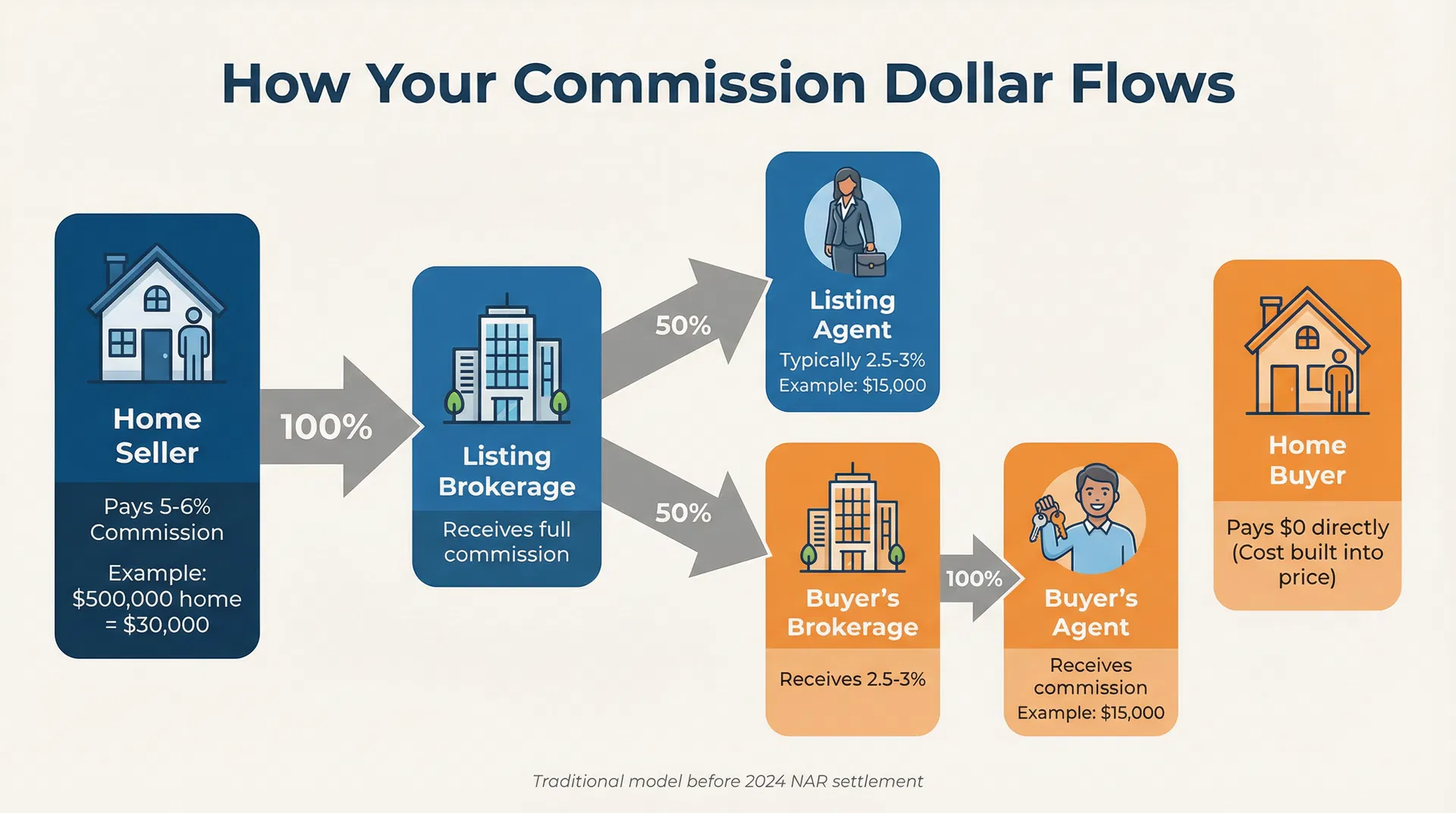
The mandatory commission system forced sellers to pay agents they never hired
The Anticompetitive Environment
On the median US home sale of $420,000, plaintiff attorneys claimed the typical seller paid approximately $12,600 to the buyer's agent—an agent the seller didn't choose, didn't interview, and who had every incentive to push for a lower sale price. In a truly competitive market, buyers would pay their own agents directly, attorneys claimed. But NAR's rule forced sellers to bear this cost, effectively baking it into the home's sale price.
(DISCLOSURE: There is no standard, fixed, or required commission rate in real estate. All commission rates are fully negotiable — by law and in practice. Any commission figures, percentages, or fee structures referenced in this publication are used strictly for illustrative purposes and should not be interpreted as typical, customary, recommended, or representative of what any buyer or seller should expect to pay. Consumers always have the right to negotiate the terms of any compensation arrangement with their agent or brokerage.)
By mandating a blanket offer, the rule prevented buyer agents from competing on price to attract clients. This, in turn, kept commission rates artificially high.
If your home offered a 2.5% buyer agent commission but the house next door offered 3%, some buyer agents would steer their clients away from your home—even if it was a better fit. You'd never know it happened.
The evidence showed that buyer agents would often "steer" their clients toward properties offering higher commission splits, regardless of the home's suitability for the buyer. This created a perverse incentive that harmed both buyers and sellers—and it was all hidden from view.
Legal Strategies Guide
While united in their core legal theory, each firm brought unique strengths and strategies to the table.
Case Origination & Investigation
Deep-dive investigation, identifying the key NAR rule after a tip from a consumer advocate. Saw the opportunity where others had failed for decades.
Economic Analysis & Evidence
Focused on the historical context of the NAR rules and the failure of previous DOJ investigations to effect change.
Trial & Witness Strategy
Called industry leaders (CEOs of NAR, Keller Williams, etc.) as witnesses, using their testimony to expose the inner workings of the industry.
Settlement & Negotiation
High risk tolerance, anticipating a trial from the outset due to the existential threat to the industry.
Public Messaging & Framing
Positioned the case as a long-overdue reform of a broken system.
The Sitzer/Burnett Trial
The October 2023 Sitzer/Burnett trial resulted in a stunning $1.8 billion jury verdict. But this wasn't just a legal milestone—it was a jury of ordinary Americans saying: this system is unfair, and it needs to change.
The trial serves as a masterclass in how the plaintiffs' attorneys made complex antitrust law understandable and personal for everyday homeowners.
A Simple, Relatable Narrative
The plaintiffs' attorneys successfully framed the complex antitrust issues in a way that was easy for the jury to understand: sellers were being forced to pay the buyer's agent, and this was unfair.
Damning Witness Testimony
By putting the CEOs of NAR and major brokerages on the stand, the plaintiffs' attorneys were able to use the defendants' own words to paint a picture of an industry that was resistant to change and determined to protect its commission structure.
Compelling Economic Evidence
The jury was presented with clear evidence that U.S. commission rates were out of step with the rest of the world, and that the rise of online home search had diminished the role of the buyer's agent, making the high commissions even more egregious.
The Door Is Open. Will You Walk Through It?
These lawsuits have opened the door to a more competitive and transparent real estate market. Cohen Milstein, Hagens Berman, and Susman Godfrey didn't just win billions in settlements—they won you the right to negotiate, to ask questions, and to demand transparency.
But the door only stays open if consumers walk through it.
What You Can Do Now:
- •Know your rights. Commissions have always been negotiable—the industry just made it feel like they weren't.
- •Negotiate your commissions. Don't accept "that's just how it works" as an answer.
- •Ask questions your agent doesn't want you to ask. How much are you being paid? Who's paying you? What would you charge if I paid you directly?
- •Check if you're eligible for settlement money. If you sold a home during the class period, you may be entitled to compensation.
The era of "that's just how it works" is over.
See What You'll Receive
Preview our weekly digest to see the comprehensive lawsuit updates, practice tips, and case analysis delivered to your inbox every Tuesday morning
Top Story This Week
Gibson Settlement Receives Final Approval - $42M Distribution Begins
Five brokerages including William Raveis and Howard Hanna received final court approval for their combined $42M settlement. Class members who filed claims by the December 30 deadline can expect payments within 60-90 days.
Read full analysis →Case Updates
Class certification motion hearing scheduled for March 15, 2026
DOJ files amicus brief supporting plaintiffs' antitrust claims
Practice Tip of the Week
Buyer-Broker Agreement Best Practices
With mandatory written agreements now in effect, ensure your forms clearly state: (1) your compensation amount or percentage, (2) who pays it, and (3) the agreement duration. Consider offering tiered service packages with corresponding fee structures.
This is a preview of what you'll receive every Tuesday at 9 AM ET
The CFPB announced a new initiative to combat redlining practices in mortgage lending, with a focus on algorithmic discrimination and digital redlining.
Federal court grants plaintiffs' motion to proceed with discovery in the Optimal Blue antitrust litigation, allowing access to pricing platform data.
Following the Cypress/Rushmore settlement, Massachusetts AG announces investigation into additional mortgage servicers for illegal foreclosure fees.
Department of Justice announces $8.5M settlement with national mortgage lender for discriminatory lending practices in minority neighborhoods.
Coalition of consumer advocacy groups calls on CFPB to strengthen RESPA enforcement and close loopholes allowing mortgage kickback schemes.
Class action filed against Wells Fargo alleging new Truth in Lending Act violations related to mortgage rate lock disclosures.